
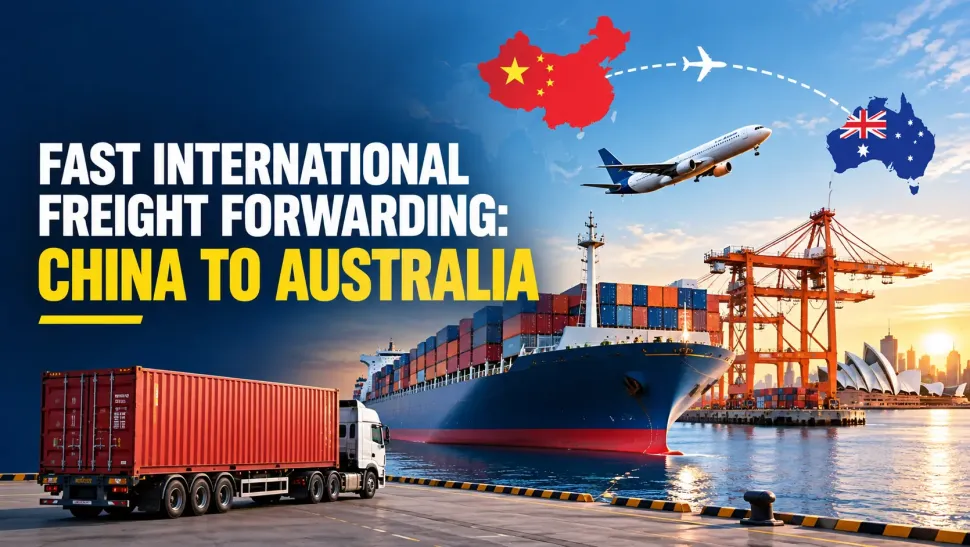
China is the largest trading partner and, for most Australian businesses, at least a part of the supply chain goes through China’s port or factory. The China-to-Australia freight lane is one of the busiest routes in the world and this is good news for pricing and options, but it can also mean delays, congestion and paperwork errors can have a greater impact than on lesser busy routes.
There may be a deadline to deliver freight to China from Australia, such as a retail launch date, or the need to keep inventory full before you sell out, and how you plan it will make a huge difference. This guide discusses the quickest shipping options options available, realistic times for shipping, and how the right freight forwarder can save you days or weeks in your supply chain.
Quick Answer
Air freight is the quickest way to transport goods from China to Australia, normally requiring 2-6 days for door to door transport. Express sea freight and direct Ocean (Non-transshipment) options are available for certain lanes, cutting down the average sea freight time from 3-4 weeks to 10-14 days. The ability of your Fast international freight forwarding to pre-clear customs, prepare all documentation in preparation for the vessel or flight, and route your goods to the most efficient Australian port for your end destination are also of great importance when it comes to speed. Under the China-Australia Free Trade Agreement (ChAFTA), businesses can also benefit from such duty assessment delays and costs being lowered if their certificate of origin documentation is complete.
Why the China-Australia Freight Lane Matters
Australia has a large trade volume with China, from raw materials to furniture, from electronics to machinery. Frequent sailings and multiple daily flight options are a benefit for speed because volumes are so high. The larger sizes provide greater scheduling flexibility and transshipment options to the user, and also provide generally more competitive rates than smaller, less-serviced trade lanes.
It is also facilitated by the China-Australia Free Trade Agreement (ChAFTA) that has been in effect since December 2015. If the necessary certificate of origin documentation is attached to a shipment, under ChAFTA, a significant portion of goods traded between the two countries have reduced or zero import duties. For businesses with only occasional shipments, the added cost savings can make a significant difference in landed cost, and an understanding of the ChAFTA requirements by your broker can prevent your shipment from being delayed because of a missing origin certificate or an origin certificate incorrectly completed.
Your Fastest Freight Options From China to Australia
Air Freight (Fastest)
Air freight from the major Chinese air freight centers, such as Shanghai, Guangzhou, Shenzhen, and Hong Kong to any of Australian cities generally takes 2-6 days, depending on the route, the carrier, and the flight path.
Air freight suits:
- Time-sensitive product launches
- High-value electronics or components
- Urgent restocks when inventory has run low
- Samples and prototypes needed quickly for approval
The compromise is price. Air freight charges are based on weight (or volumetric weight) and for bulky low value freight, may cost several times more per kg than sea freight.
Express or Priority Sea Freight
Not all sea freight is fast. Typically, one or more transshipment stops are part of the standard sea freight package from China, in which case goods are moved from one ship to another at a port of call. This can extend transit time by days, if not weeks.
Reducing this can be done by direct sailings – one vessel sails directly from one Chinese port to one Australian port without transshipment. Transit time is reduced to approximately 10-14 days for some direct lanes, versus 3-4 weeks for a lane with multiple transshipment stops. If the sailing is a direct sailing or one that requires a transfer, your freight forwarder should be able to tell you that before you book the sailing in question. This is not always evident from a simple rate quote.
Air-Sea Combination (Sea-Air)
It can be a good sea-air solution if a shipment cannot be purely air freight for economy reasons, but it cannot be purely sea freight due to its delay. The first, longer leg of the journey is by sea, normally ending at a transshipment centre, and the final leg is by air. This is not as prevalent on the China-Australia lane in particular, as there are already well-established direct sea and air services available, but it can be helpful for longer-haul, international shipments with multiple legs.
Standard FCL and LCL Sea Freight
If speed is not as critical as cost, then standard Full Container Load (FCL) or Less than Container Load (LCL) sea freight is the most cost-effective choice. Sailings take approximately 2-4 weeks, depending on the origin and destination port, and direct sailings.

Key Chinese Ports and Their Australian Counterparts
Where your cargo departs from, and where it lands, both affect total transit time.
Major Chinese origin ports:
- Shanghai – China’s largest port, with the widest range of sailing frequencies to Australia
- Ningbo-Zhoushan – One of the busiest ports globally, strong connectivity to eastern Australia
- Shenzhen (Yantian) – A key hub for electronics and manufactured goods heading south
- Guangzhou – Strong for general manufacturing and consumer goods
- Qingdao – A major northern China port with solid Australia-bound schedules
Major Australian destination ports:
- Port Botany (Sydney) – Primary gateway for New South Wales
- Port of Melbourne – Australia’s busiest container port overall
- Port of Brisbane – Main entry point for Queensland
- Fremantle (Perth) – Western Australia’s principal container port
One of the easiest ways to save any unnecessary days of transit from your shipment is to match the right Chinese origin port with the right Australian destination port, according to where your product is made from where it is required.
What Actually Slows Down China-Australia Freight
With this well-tended lane, shipments are still delayed. There are common causes that are important to be aware of and plan accordingly around them:
Peak season congestion. Both Christmas and around the Chinese New Year period are peak periods, with increased demand, container shortage and extended port dwell times. The best advice is to reserve weeks in advance of these dates to get the best price and best availability.
Incomplete or late documentation. If a bill of lading, certificate of origin or packing list are not available prior to departure, they may delay customs clearance after goods have been imported to Australia.
Missing ChAFTA certificates of origin. If no certificate of origin is issued, your goods may not be eligible for preferential duty treatment under ChAFTA and this can also result in a longer manual processing time by the Australian Border Force.
Biosecurity holds. Treatment or inspection by the Department of Agriculture, Fisheries and Forestry (DAFF) is a common requirement for wooden packaging, some food products and used machinery, and can add days if treatment is not completed prior to packaging.
Transshipment delays. A sailing via an intermediate port, such as Singapore or a port in Southeast Asia, includes a transfer port and any delay at the transfer port will directly impact the date of delivery.
Poor coordination between freight and customs. If both the transport and clearance are done by different companies, you can get days lost in the process if there is a small misunderstanding between the two, which would only be noticed once the goods are already at the wharf.
How to Speed Up Your China-Australia Shipments
A few practical habits make a measurable difference to how fast your freight actually moves:
- Prepare export documentation early, ideally before your supplier finishes packing the goods, not after the vessel has already sailed
- Confirm certificate of origin eligibility upfront if you want to claim ChAFTA preferential duty rates, since retroactive claims are harder and slower to process
- Ask specifically whether a sailing is direct or transshipped before booking, particularly if timing is tight
- Pre-lodge your customs entry with your broker before the vessel arrives, so clearance can begin the moment the ship docks rather than after
- Flag biosecurity-sensitive cargo in advance, so any required treatment can be arranged before arrival instead of causing a hold once the container is already at the port
- Choose the Australian port closest to your final delivery point, reducing inland transport time after the ship or flight lands
- Work with one forwarder who manages both transport and customs, cutting out the communication gap between two separate businesses
Freight Forwarder vs Customs Broker on This Route
Coordination between transport and customs clearance does not come into the picture much less than usual on a high-volume lane, such as China to Australia, as there will be more activity in the same port slots and inspection resources.
A freight forwarder is responsible for reserving the space for goods moving by sea or air from the Chinese factory or port to your delivery address in Australia. A customs broker is someone who lodges customs declarations with the ABF and is a licensed customs broker, who provides tariff classification, duty and GST calculation, ChAFTA certificate of origin claims and the actual import declaration to the ABF.
Many successful China-Australia freight forwarders already have their own customs broker licence or have nominated customs brokers and eliminating a coordination step often results in swifter clearance, as booking and customs information are in the same system and not passed between two or more companies
What to Look for in a Fast China-Australia Freight Forwarder
Speed on this lane comes down to a handful of practical factors:
- Direct carrier relationships with shipping lines and airlines serving major Chinese ports, rather than relying entirely on third-party space bookings
- In-house customs clearance, so your declaration can be pre-lodged and ready the moment your cargo arrives
- Familiarity with ChAFTA documentation, to avoid losing preferential duty treatment over a paperwork error
- Real-time shipment tracking, so delays are flagged early rather than discovered after the fact
- Experience across both air and sea freight, so you can be advised honestly on which option actually suits your timeline and budget, rather than being pushed toward whichever service the forwarder happens to specialise in
- A physical presence in both countries or strong local partnerships, which usually means faster problem-solving when something does go wrong at either end
Documents That Keep a Fast Shipment Fast
Even the fastest freight service moves at a snail’s pace if the paperwork is not in place. When shipping to China, make sure you have these ready before you depart from the originating port/airport:
- Commercial Invoice – States the transaction value and is used to calculate duty and GST on arrival
- Packing List – Details what’s in each carton or container, including weights and dimensions
- Bill of Lading (sea) or Air Waybill (air) – The core transport document and proof of shipment
- Certificate of Origin – Required to claim preferential duty treatment under ChAFTA
- Packing Declaration – Confirms whether wood packaging materials meet Australian biosecurity treatment standards
- Import Declaration – Lodged electronically by your licensed customs broker with the Australian Border Force
Faster clearance on arrival is the norm for businesses that also send these documents to their forwarder/broker when the goods are packed, not after they have already sailed or flown. It may seem like a minor thing, but it’s one of the most effective methods of securing your time on transit.
Balancing Speed and Cost on This Route
In almost all cases, the faster the better, but the price difference isn’t always as great as people think. The price premium for air freight is usually higher than sea freight, often many times as high, so is best suited to smaller volumes, higher value or truly urgent cargo rather than normal inventories.
Sea sailings that are made directly, without transshipment, are in a helpful middle range. Generally they are not much more expensive than a regular transshipped sailing, but the difference in price is related to carrier/capacity, and not the route structure itself, and can save a week or more in transit. When you are not being told by your freight forwarder which sailings are direct, it is worth asking your freight forwarder directly because it may be the lowest cost speed upgrade option on the entire shipment.
A mixed strategy is best suited where businesses regularly send out goods (standard sea freight) and have stocks replenished on a planned basis, while urgent cases, including stock-outs, new product launches and customer commitments which cannot be postponed, are sent by air freight.
Frequently Asked Questions
Do I need separate insurance for faster freight options like air freight?
Cargo insurance can be considered regardless of the transport mode, because the liability of the carrier, as specified in the shipping or aviation terms and conditions, is generally limited and is not likely to cover the actual replacement cost of the cargo. Insurance coverage is usually a worthwhile investment for high-dollar or time-sensitive shipments since the expense is relatively small compared to the coverage it affords against loss or damage during shipment.
How long does freight forwarding from China to Australia take?
The usual air freight time is 2-6 days. It may take some time to ship in direct sea freight without transshipment around 10 to 14 days in some routes, and for standard sea freight with transshipment, it is around 3 to 4 weeks.
What is the fastest way to ship from China to Australia?
Air freight is the fastest choice, usually being delivered within a week. If you want to send a shipment at a lower price but still want some speed, the next fastest option would be direct sea freight – no transshipment stops.
Does ChAFTA reduce shipping time as well as cost?
ChAFTA does not directly shorten transit times, it only lowers or removes import duty. Having a certificate of origin with the correct completion and authorized in advance, however, can avoid delays due to manual customs review, resulting in indirect speeding up of clearance.
Which Chinese ports have the best connections to Australia?
All of these have strong, frequent sailings to the ports of Australia and will be reliable when it comes to speed and cost, including Shanghai, Ningbo-Zhoushan, Shenzhen and Guangzhou.
Is air freight always faster than sea freight from China?
For almost all the cases where the sole purpose is transit time, yes. But the overall door to door time also relies on the speed of customs clearance and inland delivery time, meaning that sometimes a well-coordinated sea freight shipment with quick customs clearance time can beat a poorly-coordinated air shipment.
Can one company handle both freight forwarding and customs clearance for China-Australia shipments?
Yes. Numerous freight forwarders on this lane have their own Australian customs broker licence, or they have licensed customs brokers who work for them, so they can book a transport and clear the goods themselves – rather than through two different companies.
What causes the most delays on China-Australia freight shipments?
Prem Christmas and Chinese New Year congestion, missing ChAFTA certificates of origin and biosecurity holds are the most prevalent delays on this route.
The Bottom Line
The China-Australia freight lane has a higher speed compared with most trade lanes, ranging from air freight to direct sea sailings that can save one to two weeks compared with the standard transshipped trade lane. The actual distinction between fast send and delayed send is often in the preparation – having documentation ready in advance, ensuring that the product is eligible for ChAFTA treatment, and having a freight forwarder who can move the cargo and clear it through customs without all the handovers.
Think Global Logistics has been operating in the freight forwarding market between China and Australia since 2014 and can provide air freight, direct and standard sea freight services and also in-house licensed customs clearance from our Sydney head office. Contact us to discuss your next shipment, or simply request a quote
