
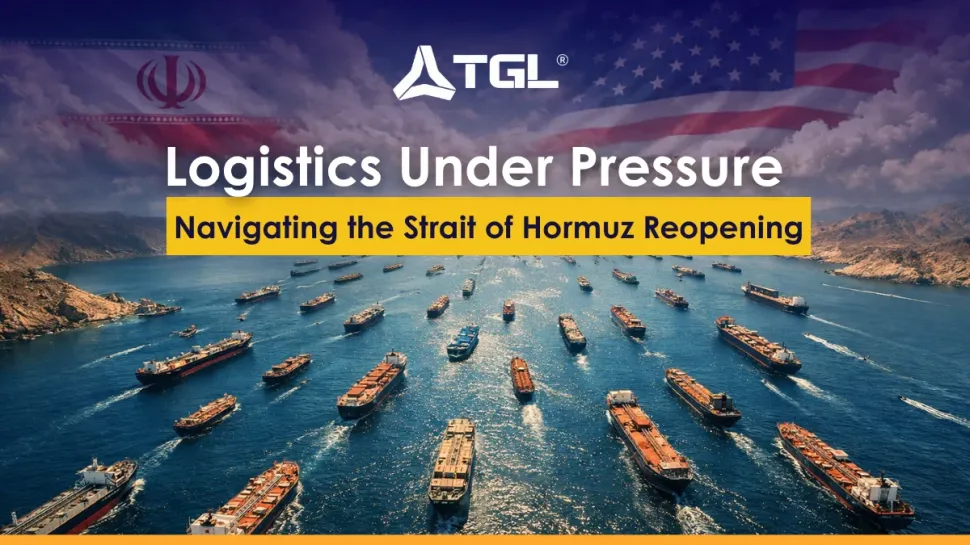
Iran declared a 14-day closing of the Strait of Hormuz in April 2026, after succumbing to diplomatic efforts by Pakistan in Islamabad. This provisional window enables commercial ships to traverse through the most critical maritime chokepoint in the world, alleviating a months-long shipping crisis in the entire world. To Australian importers and exporters, this implies a direct chance to clear backlogged cargo, and reduce transit times. Companies need to liaise with freight forwarding companies to take care of the Iranian coordination policies and possible jams at the Persian Gulf ports.
The 14-Day Window: A Massive Turning Point for Global Trade
The world shipping sector has been biting its nails since weeks. Now we are free to draw a deep breath. After the highly diplomatic talks in Islamabad, Iran has accepted a two-week ceasefire. The news that the world has been waiting to hear is here: the Strait of Hormuz is opening.
At Think Global Logistics (TGL) we realize that the term logistics under pressure is not merely a slogan. It has become the order of the day to Australian businesses making efforts to get goods to market. This is a unique 14-day opportunity that has its challenges. This is a fast, precise, and accurate period to get through with the appropriate technology.
Why the Strait of Hormuz is the World’s Most Important Lane
The Strait of Hormuz is a small waterway between Oman and Iran. It is the sole means of transporting oil, gas and dry cargo in the Persian Gulf to the rest of the world.
Oil Flow: More than a quarter of the global oil consumption flows through here every day. Lack of this lane causes the energy prices in Australia to shoot up within no time.
Australian Impact: A big part of our fuel, chemicals and plastic polymers depend on this route.
The Detour Cost: When the Strait is closed ships must sail around the whole continent of Africa (the Cape of Good Hope). This will increase the additional miles by approximately 3,500, the duration of time taken by a week, and millions of dollars in fuel expenses.
The reopening, which was mediated by Pakistan, is already making a ripple effect in the news. Oil prices in the world plummeted 10 percent in hours. However, 14 days is a very short time in the world of shipping. The average container truck does not travel like a vehicle, it takes days to alter its route.
What This Means for Australian Importers and Exporters
As a business owner, whether you are in Sydney, Melbourne or Brisbane, you must be experiencing the logistics pressure. This re-opening has a direct impact on your bottom line. The following is a further breakdown of the impacts of this in various sectors of the Australian economy.
Clearing the Backlog
Hundreds of ships are now lying at anchor, or proceeding slowly, in the Indian Ocean, awaiting news. With the gates open, now there will be a tremendous rush. This is known as a bottle-neck surge. Although the cargo will at last begin to move, the influx of the large number of ships simultaneously will lead to a congestion of the major Australian ports such as Port Botany and Port of Melbourne.
Freight Rate Volatility
Even as the fuel prices are declining, there is an increase in the demand for ship space. There are surcharges that some carriers might impose, such as peak season surcharges or emergency window fees. TGL is committed to price transparency. We do it to make sure that our clients are not charged with unjust prices simply because they are attempting to transfer goods within this period.
Retail and Inventory Levels
Australian retailers have been grappling with the problem of out of stock messages months on. This 14-day will provide the best opportunity to restock the second half of 2026. It could be electronics or car parts or raw materials to make your own stuff, and it is important to have your goods on a ship in the next two weeks to have a successful 3rd and 4th quarter.
Regional Breakdown: Impact on Australian Cities
Sydney (The Hub): As our home base, we see the pressure on Sydney businesses every day. The opening will assist the local construction companies to access the materials required in continuing with infrastructure projects.
Melbourne (Manufacturing): In the case of the automotive and manufacturing industries in Melbourne, the supply of specialized parts in Europe and Middle East is critical. A just-in-time delivery reset is possible with this window.
Brisbane & WA (Resources): The mining and resource industries are dependent on heavy machinery. A lot of these are via the Gulf. These companies could have saved millions in lost project costs of a 14-day opening.
Step-by-Step Guide: How to Navigate the Next 14 Days
This ceasefire cannot be an inactive one on your part. You have to have an aggressive plan. The following is the TGL suggested checklist on passing through Strait of Hormuz reopening.
Emergency Cargo Audit
See your orders at present. Which are the most pressing? Determine the cargo that is now in transit or languishing at one of the ports close to the Gulf (such as Jebel Ali). You must have a priority list in terms of need-to-have vs nice-to-have.
Immediate Communication
Now is not the time to make use of automated emails. You should Talk to the TGL team who is aware of the ground reality. We offer one point of contact at TGL. Your special guide will inform you precisely what ships are following the Hormuz route, and which are on the detour.
Prepare Your Documentation
The re-opening of Iran comes at a price: “Coordination. To pass through the waters safely, the ships are required to give certain data to the authorities of Iran. This contains cargo lists and crew lists. In case of an incorrect paperwork, your cargo will remain detached. These temporary 2026 protocols are already informed by our customs clearance team in Australia.
Use Real-Time Visibility Tech
During a crisis, information is power. TGL digital portal will provide you with a bird-eye view of your supply chain. When one ship is caught in a traffic jam at the Strait, you will be informed at once and be able to remind your own customers and to manage expectations.

The TGL Advantage: Why Technology Wins in 2026
In 2026 logistics is no longer a question of trucks and ships. It is about data. We have developed our brand at Think Global Logistics on the notion technology is Your Advantage.
As the Strait of Hormuz was shut down, our AI-driven systems started computing the alternative paths to our clients right away. Since it has been reopened, the same systems are establishing the swiftest vessels to get back to track.
Speed of Information: Our clients were aware of the deal that Pakistan mediation almost as soon as the news was published on the wires.
Middle East as Complexity Simplified: We take the complex geopolitical situation of the Middle East and reduce it to a simple Yea/No to your shipping schedule.
B Corp Ethics: We do not cut corners even when in a hurry. Your logistics are ethical and transparent with us.
Sustainability and the B Corp Mindset
As a Certified B Corp, we consider the environmental cost of logistics. Transporting cargo within Africa consumes a lot of fuel as compared to transiting via the Strait of Hormuz.
In assisting our clients in transporting cargo across the reopened Strait, we are, in fact, assisting them in reducing the carbon footprint of their supply chains. We believe that efficient logistics and “green” logistics go hand-in-hand. This 14 days timeframe is an opportunity to resume more efficient, less wasteful shipping routes. It demonstrates that peace and diplomacy are both beneficial to the economy and the planet.
Logistics Glossary: Understanding 2026 Terms
To get you through your next meeting, here are some of the terms that you will hear most in the next 14 days:
Chokepoint: A small waterway that is easily obstructed. The Strait of Hormuz is the most important choke point of the world.
Blank Sailing: When a shipping line cancels a scheduled stop. We think this 14 day window will have less blank sailings.
3PL (Third-Party Logistics): This is what we provide at TGL to run your supply chain and you to concentrate on your business.
SGE (Search Generative Experience): How Google AI summarizes news like this. This blog is meant to assist you appear there!
Intermodal: Transporting products by several means of transfer (Ship to Train to Truck).
Risk Management: The “Post-14 Day” Strategy
Day 15 What is happening? Every savvy entrepreneur ought to be asking that. The talks in Islamabad are still underway and no one is sure that the Strait will remain open.
TGL’s Long-Term Advice:
Do not quit Your Alternative Routes: When you have a good route that goes through alternative ports, maintain it. Don’t put 100% of your cargo into the Hormuz basket.
Invest in “Buffer” Stocks: This is a 14-day window to stock up on additional inventory. With another closure of the Strait in May, you would like to have your stock in your Australian warehouse to see you through the winter.
Upgrade Your Partner: Since your current freight forwarder has not been communicating with you in this crisis, you need to switch your partner to one like TGL that values people and technology.
FAQ’s
Is it actually safe for ships to pass through right now?
Yes. Under the 14-day agreement mediated by Pakistan, Iran has guaranteed safe passage for commercial vessels. However, ships must follow specific “coordination” rules with the Iranian Navy.
How will this affect my shipping costs to Australia?
You should see a stabilization in fuel surcharges. However, because everyone is trying to ship at once, port fees might increase temporarily due to demand. TGL provides transparent quotes to help you manage this.
What if my cargo is already on a ship going around Africa?
Most ships already on that route will finish their journey because turning around would cost more. However, for new bookings made this week, the Hormuz route will save you roughly 10 to 15 days of transit time.
Does TGL handle customs for these Middle Eastern routes?
Absolutely. Our Sydney-based team specializes in Australian customs regulations and the specific documentation required for Middle Eastern transit. We ensure you stay compliant.
Why was Pakistan the mediator?
Pakistan maintains strong diplomatic ties with both Iran and the West. Their “10-point proposal” in Islamabad provided a neutral ground for both sides to agree on a temporary humanitarian and trade window.
Conclusion
The greatest event in global trade up to 2026 is the reopening of the Strait of Hormuz. The 14-day limit makes it a great deal of pressure but a great deal of opportunity to those who do it quickly.
We are prepared to guide you through this at Think Global Logistics. We are a blend of a B Corp and a tech company. We are not merely a freight carrier, but we are saving your life and business in a very turbulent world.
It is putting a strain on logistics, yet you need not. To address the TGL team, contact them today. Let’s have your cargo out of the Strait and back to your warehouse where it belongs.
